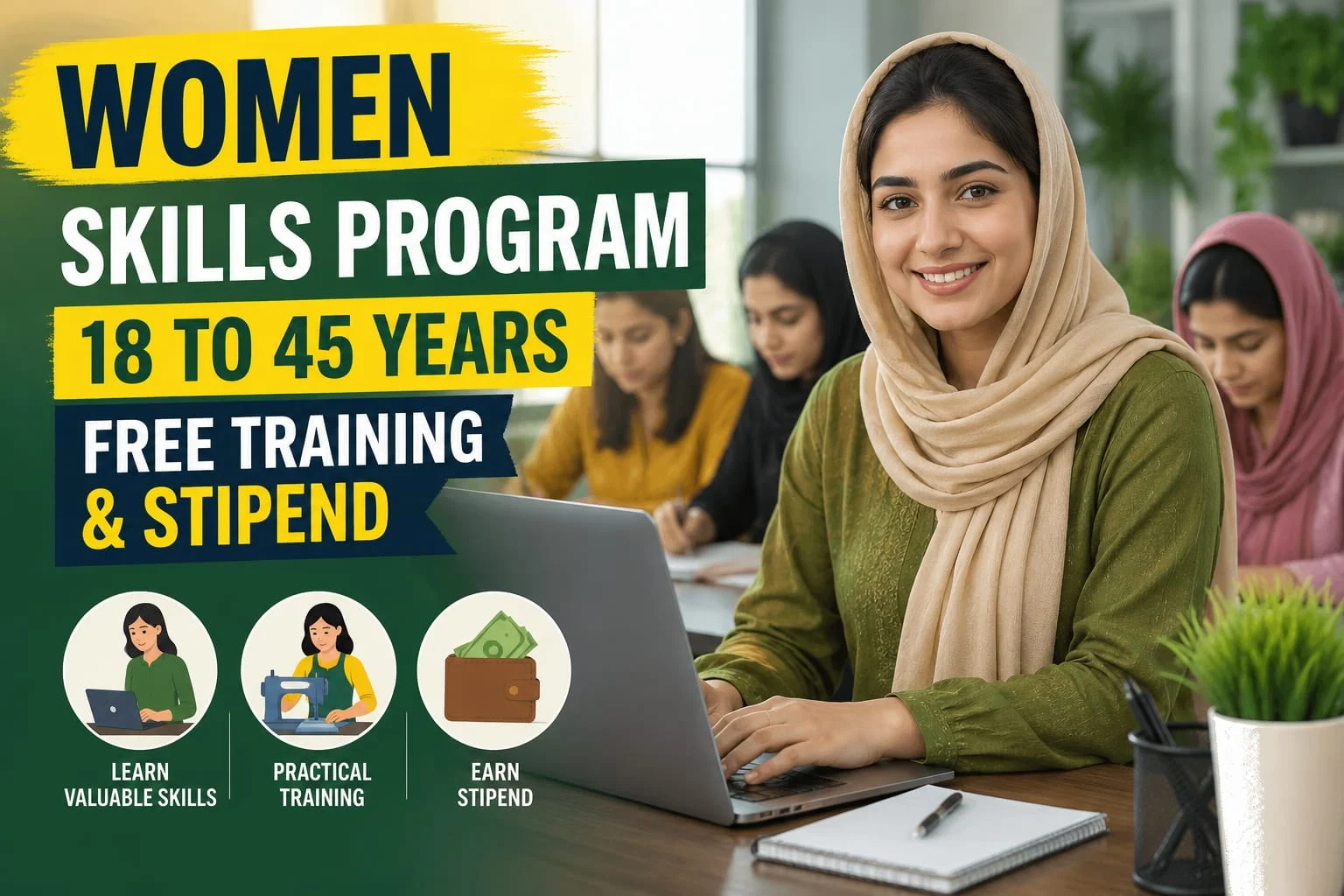
“Women Skills Program” isn’t the name of a single scheme in Pakistan — it’s become a general term people search for a handful of government-backed initiatives that share the same goal: giving women free technical and digital training, along with a monthly stipend, so they can build income independently, whether that’s a job, freelancing, or a small home-based business.
Because several different programs run under this general idea — some federal, some provincial — it’s easy to get confused about which one to apply to. This guide breaks down the major women’s skills programs active in Pakistan, their eligibility rules, and how to apply for each, so you can identify exactly which one fits your situation.
Why These Programs Matter
Skills-based training programs for women address a specific, well-documented gap: many women in Pakistan have the ability and motivation to work but face real barriers — limited access to training institutes, mobility restrictions, financial constraints, or household responsibilities that make full-time, in-person education difficult.
These programs are designed around that reality by offering:
- Free training with no course fees
- Monthly stipends to support participation, since unpaid training isn’t realistic for many households
- Free equipment in several programs, such as laptops or desktop computers and internet devices
- Home-based or flexible training models for courses like tailoring, embroidery, and digital skills, reducing the need to travel daily
Major Women Skills Programs in Pakistan (2026)
1. NAVTTC Free Skills Training (Federal)
Run by the National Vocational and Technical Training Commission (NAVTTC) under the Prime Minister’s Youth Programme, this is the largest nationwide vocational training initiative in Pakistan, open to applicants across all provinces — not limited to one region.
Key features:
- Fully funded technical and vocational training with no course fees
- Monthly stipend during the training period
- Female-specific course tracks, including beautician, tailoring, embroidery, food processing, healthcare assistance, and IT for women
- Dedicated female-only batches at many training institutes
- Some courses (particularly tailoring and food processing) run as home-based or community-center models to reduce mobility barriers
- Certificates recognized by HEC Pakistan and provincial TEVTA bodies, and accepted by many international employers, including in Gulf countries
How to apply: Female applicants register through the official NAVTTC portal at navttc.gov.pk, using the same application process as general applicants, with no additional documentation required specifically for women.
2. PSDF Digital Skills Program / “Mein Digital” (Punjab)
Run by the Punjab Skills Development Fund (PSDF) in collaboration with the Punjab Information Technology Board (PITB), this program specifically targets educated women in rural Punjab for digital and IT-related training.
Key features:
- Free digital skills training over a multi-month course period
- Free desktop computer or laptop and an internet device provided to participants
- A monthly stipend (commonly cited around Rs. 5,000), typically conditional on maintaining a minimum attendance requirement (often around 80%)
- Designed to help participants move into freelancing, remote work, or online business after completing training
Eligibility (general pattern, always confirm current batch requirements):
- Female applicants with a minimum of 16 years of education
- Age typically between 21 and 40
- Domicile of rural Punjab
- Only one PSDF course can be taken at a time, to allow more applicants access to the program
How to apply: Applications are submitted through the dedicated link on the official PSDF website or the PITB portal, with selection generally based on merit through a test or interview process.
3. e-Learn She Earn Program (Punjab)
Also backed by the Punjab government and PITB, this program is aimed at a broader age range and focuses specifically on helping women earn online from home through digital skills.
Key features:
- Completely free training, typically lasting around three months
- Support may include a laptop, internet access, and a monthly stipend for selected participants
- Designed for students, housewives, and job seekers alike — prior experience is generally not required
- Training is structured to prepare participants for freelancing, remote employment, or starting an online business
Eligibility (general pattern, always confirm current batch requirements):
- Women typically aged 15 to 35
- Residency in Punjab
How to apply: Registration is completed through the program’s official online portal, generally linked from Punjab government or PITB communications when a new batch opens.
How to Choose the Right Program for You
- Check your province first. NAVTTC is nationwide, while PSDF’s Digital Skills Program and e-Learn She Earn are Punjab-specific.
- Match your age and education level to the specific program’s eligibility criteria, since these vary significantly between schemes.
- Consider your preferred skill area. NAVTTC covers a wider range of trades (beautician, tailoring, healthcare assistance, IT), while the Punjab digital programs focus specifically on freelancing and online-earning skills.
- Check if you need to be rural or urban-based, since some programs (like PSDF’s Mein Digital) specifically target rural applicants.
Documents Typically Required
While specific requirements vary by program, most applications require:
- Original CNIC (or B-Form for younger applicants, where applicable)
- Recent passport-size photograph
- Educational certificates or transcripts matching the program’s minimum qualification
- Domicile certificate, especially for province-specific or rural-targeted programs
- An active mobile number, since most programs send updates and selection results via SMS
General Step-by-Step Application Process
- Identify the right program based on your province, age, and educational background.
- Visit the official portal (navttc.gov.pk for NAVTTC, or the relevant PSDF/PITB portal for Punjab-specific programs).
- Create an account or profile using your CNIC and mobile number.
- Fill out the application form with accurate personal and educational details.
- Upload the required documents in the format specified by the portal.
- Submit before the deadline for the current batch — these programs run in cycles, so missing one batch typically means waiting for the next intake to open.
- Attend the test or interview, if the program’s selection process includes one.
- Check your selection status through the portal or via SMS updates, and maintain the required attendance once selected to keep receiving your stipend.
Common Mistakes to Avoid
- Applying to the wrong program for your province. Punjab-specific programs are not open to applicants outside Punjab, regardless of how the advertisement is shared on social media.
- Missing the batch deadline. These programs open and close registration in cycles rather than staying open year-round.
- Applying through unofficial links. Always verify you’re using the program’s actual official portal, since fake “registration” pages have been used to collect personal data under similar-sounding program names.
- Not meeting attendance requirements after selection, which can result in losing stipend eligibility in programs where a minimum attendance percentage is required.
- Assuming eligibility criteria stay the same every batch. Age limits, education requirements, and stipend amounts can change between recruitment cycles, so always check the current announcement rather than an older one.
Frequently Asked Questions
Is there one single “Women Skills Program” I should apply to? No — several distinct programs exist, including the nationwide NAVTTC training program and Punjab-specific initiatives like the PSDF Digital Skills Program and e-Learn She Earn. Which one applies to you depends on your province, age, and educational background.
Do I need a laptop or computer already to apply for digital skills training? No. Programs like PSDF’s Digital Skills Program and e-Learn She Earn typically provide a laptop or desktop computer along with an internet device to selected participants as part of the training package.
Is the stipend guaranteed for the entire training period? Stipends are generally tied to attendance requirements. Missing the minimum attendance percentage (often cited around 80%) can result in losing stipend eligibility for that month, depending on the specific program’s policy.
Can housewives or women with no prior work experience apply? Yes. Most of these programs, including e-Learn She Earn and NAVTTC’s female-specific tracks, are specifically designed for beginners, including students, housewives, and first-time job seekers.
Where can I check if a new batch has opened? Check the official program portal directly — navttc.gov.pk for NAVTTC, or the official PSDF/PITB channels for Punjab-specific programs — rather than relying on older articles or unofficial social media posts, since batch openings and deadlines change regularly.
Final Thoughts
Women’s skills programs in Pakistan offer a genuinely valuable path to free training, practical skills, and a stipend to support the learning process — but since multiple programs run under similar names and goals, it’s worth taking a few minutes to confirm which one actually matches your province, age, and education level before applying. Once you’ve identified the right program, apply directly through its official portal, keep your documents ready, and maintain the required attendance to make the most of the stipend and training on offer.